Mysterious Fast Radio Burst Is the Closest Astronomers Have Ever Seen
तेज़ रेडियो फटना (FRBs) आज खगोलविदों के सामने शीर्ष रहस्यों में से हैं। पहली बार 2007 में खोजा गया (प्रसिद्ध “लोरिमर बर्स्ट“), इन ऊर्जावान घटनाओं में रेडियो तरंगों का भारी विस्फोट होता है जो आमतौर पर केवल मिलीसेकंड तक रहता है। जबकि आज तक देखी गई अधिकांश घटनाएं एक बार की घटनाएं हैं, खगोलविदों ने कुछ एफआरबी का पता लगाया है जो थे दोहरा प्रकृति में। इन विस्फोटों का कारण अज्ञात बना हुआ है, जिसमें से लेकर सिद्धांत हैं घूर्णन न्यूट्रॉन तारे तथा चुम्बक प्रति लोकोत्तर!
चूंकि पंद्रह साल पहले पहली घटना का पता चला था, इसलिए हमारे उपकरणों और समर्पित सरणियों में सुधार के कारण कई और खोज हुई हैं! एक अन्य मील के पत्थर में, खगोलविदों की एक अंतरराष्ट्रीय टीम ने हाल ही में सर्पिल आकाशगंगा मेसियर 81 (एम81) में स्थित एक दोहराए जाने वाले एफआरबी के उच्च-सटीक माप किए - जो अब तक का निकटतम एफआरबी है। टीम के निष्कर्षों ने दूसरों को उठाते हुए इस रहस्यमय घटना के बारे में कुछ सवालों को हल करने में मदद की है।
अंतरराष्ट्रीय टीम के शोधकर्ताओं से बनी थी रेडियो खगोल विज्ञान के लिए नीदरलैंड संस्थान (एस्ट्रोन), खगोल विज्ञान के लिए एंटोन पन्नेकोएक संस्थानद रेडियो खगोल विज्ञान के लिए मैक्स प्लैंक संस्थानद ओनसाला अंतरिक्ष वेधशालाद सैद्धांतिक भौतिकी के लिए परिधि संस्थानद वेंट्सपिल्स इंटरनेशनल रेडियो एस्ट्रोनॉमी सेंटर (VIRAC), और नीदरलैंड, जर्मनी, स्वीडन, कनाडा, चीन, भारत, इटली, यूके और यूएस में कई विश्वविद्यालय और अनुसंधान संस्थान
पत्रिकाओं में इस सप्ताह समानांतर में प्रकाशित दो पत्रों में उनके निष्कर्षों का वर्णन किया गया था प्रकृति तथा प्रकृति खगोल विज्ञान. अध्ययन का नेतृत्व संयुक्त रूप से किया गया था टीम का नेतृत्व संयुक्त रूप से फ्रांज कर्स्टन द्वारा किया जाता है, जो एक पोस्टडॉक्टरल खगोलशास्त्री है।[{” attribute=””>Chalmers University of Technology in Sweden and ASTRON, and Kenzie Nimmo, a Ph.D. student with ASTRON and the University of Amsterdam.
As they describe in their papers, the team set out to make high-precision measurements of a repeating FRB discovered in January 2020 in the constellation Ursa Major (aka. the Big Dipper). To study the source with the highest possible resolution and sensitivity, the team combined measurements from multiple instruments in the European VLBI Network (EVN) – a network of telescopes located primarily in Europe and Asia specializing in Very Long Baseline Interferometry (VLBI).
These were complemented by measurements taken from other powerful radio telescopes, like the Karl G. Jansky Very Large Array (VLA) in New Mexico. When they analyzed the measurements, they realized the repeating FRB came from the nearby spiral galaxy Messier 81 (M 81). This galaxy is located about 12 million light-years from Earth, making this event the closest FRB detected to date. As Kirsten explained in a recent Chalmers press release:
“We wanted to look for clues to the bursts’ origins. Using many radio telescopes together, we knew we could pinpoint the source’s location [in] अत्यधिक सटीकता के साथ आकाश। इससे यह देखने का मौका मिलता है कि तेज़ रेडियो फटने का स्थानीय पड़ोस कैसा दिखता है। ”
सर्पिल आकाशगंगा मेसियर 81 (एम 81) के बाहरी इलाके में प्राचीन सितारों (लाल रंग में) के बीच छिपा हुआ एक चुंबक चमक। श्रेय: डेनियल फ़ुत्सेलार, artsource.nl
क्या अधिक है, टीम ने आकाशगंगा के बाहरी इलाके में FRB का पता लगाया और महसूस किया कि यह बहुत पुराने सितारों (एक गोलाकार क्लस्टर) के घने समूह से आना था। यह एक अप्रत्याशित खोज थी, क्योंकि कई FRB युवा, बड़े पैमाने पर, अल्पकालिक सितारों और हमारे सूर्य के द्रव्यमान से कई गुना घिरे हुए हैं। ये तारे अत्यंत घने और अत्यधिक चुम्बकित सफेद बौनों के रूप में अपना जीवन समाप्त करते हैं जिन्हें चुम्बक के रूप में जाना जाता है।
कर्स्टन ने कहा, “एक गोलाकार क्लस्टर से तेज़ रेडियो बर्स्ट का पता लगाना आश्चर्यजनक है।” “यह अंतरिक्ष में एक ऐसी जगह है जहाँ आपको केवल पुराने सितारे मिलते हैं। ब्रह्मांड में आगे, तेज रेडियो फटने उन जगहों पर पाए गए हैं जहां तारे बहुत छोटे होते हैं। यह कुछ और होना था।” जैसा कि उल्लेख किया गया है, खगोलविदों का मानना है कि एफआरबी चुंबकीय बनने के लिए गुरुत्वाकर्षण के पतन के दौर से गुजर रहे युवा सितारों का परिणाम है। यह हाल के वर्षों में अनुसंधान के एक महत्वपूर्ण निकाय द्वारा पैदा हुआ है।
हालाँकि, इन नवीनतम निष्कर्षों से पता चलता है कि वे मैग्नेटर्स से जुड़े हो सकते हैं जो तब बनते हैं जब a[{” attribute=””>white dwarf became massive enough to collapse under its own weight – something that has been predicted but never before seen. Team member Jason Hessels, a professor with the University of Amsterdam and ASTRON, explained:
“We expect magnetars to be shiny and new, and definitely not surrounded by old stars. So if what we’re looking at here really is a magnetar, then it can’t have been formed from a young star exploding. There has to be another way.”
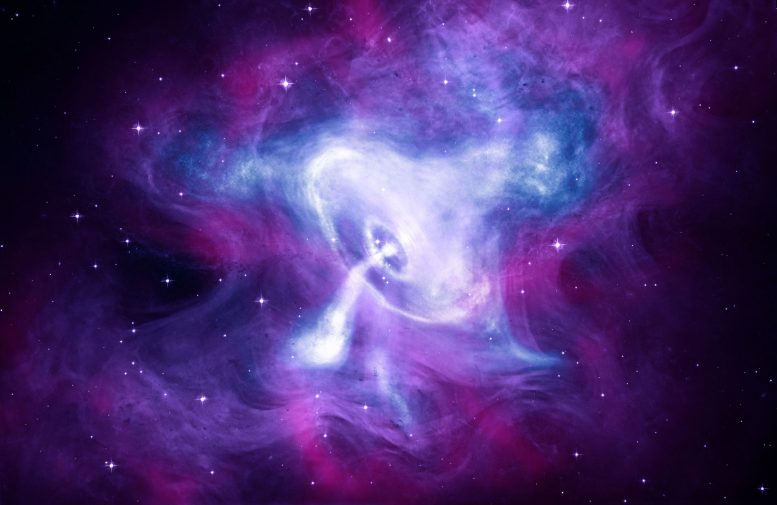
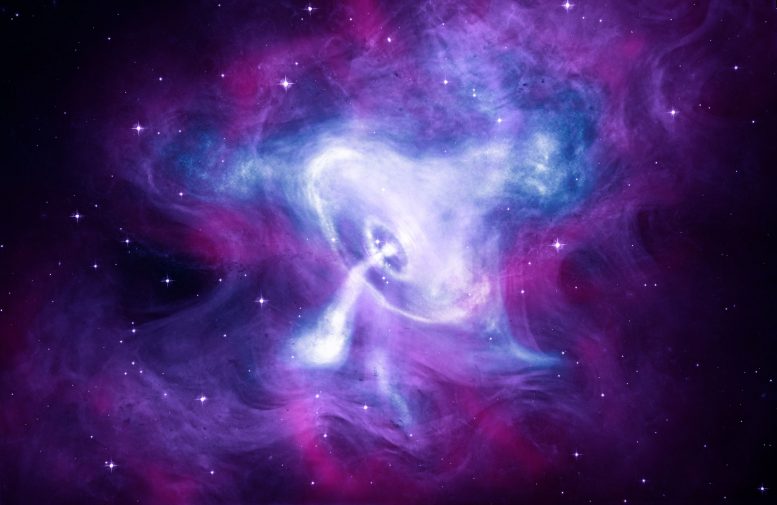
A new composite image of the Crab Nebula features X-rays from Chandra (blue and white), optical data from Hubble (purple), and infrared data from Spitzer (pink). Credit: NASA
In globular clusters, many stars exist as binary systems, some of which get close for one star to collect material from the other. This often occurs when one star is no longer in its main sequence and expands to become a Red Giant. The companion will begin to siphon material from the Red Dwarf’s outer layers, eventually leading to a situation known as “accretion-induced collapse.”
“If one of the white dwarfs can catch enough extra mass from its companion, it can turn into an even denser star, known as a neutron star
” data-gt-translate-attributes=”[{” attribute=””>neutron star,” said team member Mohit Bhardwaj, a Ph.D. candidate at McGill University and a member of the Canadian Hydrogen Intensity Mapping Experiment (CHIME). “That’s a rare occurrence, but in a cluster of ancient stars, it’s the simplest way of making fast radio bursts.”
After zooming in on their measurements to look for additional clues, the astronomers found something else that surprised them. Some of the flashes they observed were shorter in duration than expected, lasting for nanoseconds (one-billionth of a second) rather than milliseconds (one-thousandth). This is similar to what has been observed from a pulsar
” data-gt-translate-attributes=”[{” attribute=””>pulsar in the Crab Nebula, a tiny, dense remnant of a supernova explosion that was seen from Earth in 1054 CE. Said Nimmo:
“The flashes flickered in brightness within as little as a few tens of nanoseconds. That tells us that they must be coming from a tiny volume in space, smaller than a soccer pitch and perhaps only tens of meters across. Some of the signals we measured are short and extremely powerful, in just the same way as some signals from the Crab pulsar. That suggests that we are indeed seeing a magnetar, but in a place that magnetars haven’t been found before.”
In the near future, observations of this system and others like it will help astronomers tell if the source is an unusual magnetar, an unusual pulsar, a black hole